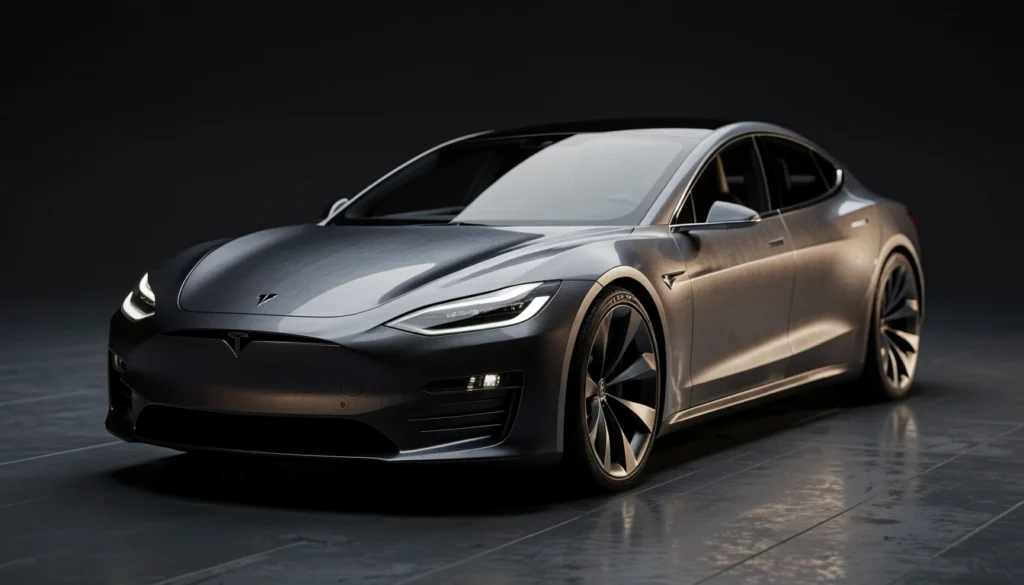
The 2026 Tesla Model 2 “Redwood”: The $25,000 EV That Will Change Everything
Imagine this You walk into a showroom and drive out in brand new electric car for less than the average used Corolla. It charges quickly, drives itself on highways and gets software updates that make it better every month. This isn’t a fantasy an this is the imminent reality of the 2026 Tesla Model 2 “Redwood”. Codenamed after the resilient tree this compact hatchback represents Tesla’s most important project since the Model 3 an affordable, mass market EV designed to finally bring electric mobility to the millions and not just the millionaires. It’s trending because it promises to do what no other automaker has managed an make EVs truly accessible.
Key Facts
- Target Price: $25,000 before incentives
- Platform: Next-Gen “Unboxed” Platform with revolutionary manufacturing
- Range: Targeting 250+ miles (EPA)
- Charging: Tesla V4 Supercharger compatible, 10-80% in ~15 minutes
- Autonomy: Hardware for Tesla Vision (no radar), capable of basic Full Self-Driving
- Size: Compact hatchback, slightly smaller than a Model 3
The Mission: Democratizing Electric Transport
Elon Musk’s master plan from 2006 is finally reaching its final stage an its “Create a low cost family car.” The Model 2 exists to be the electric Corolla the default an sensible, affordable choice for first time car buyers, students, urban dwellers and families needing a second car. With global EV adoption hitting affordability barriers an this car isn’t just a product, it’s a strategic necessity for Tesla’s growth and for the world’s transition to sustainable transport. Its success could make Tesla the Volkswagen of the 21st century.
The “Unboxed” Revolution: How They’ll Hit $25,000
The price isn’t magic it’s manufacturing innovation. Tesla’s “Unboxed” process is a radical departure from traditional assembly lines:
- Large Subassemblies: Cars are built in fewer, larger modules that are assembled simultaneously rather than sequentially.
- Gigacasting: The front and rear underbodies are each single aluminum castings an reducing parts by hundreds.
- 48 Volt Architecture: Cuts copper usage by 75%, reducing weight and cost.
- Battery Integration: New LFP (Lithium Iron Phosphate) battery cells are structural an forming part of the car’s chassis.
- Parallel Assembly: Multiple sections of the car are worked on at once, cutting assembly time by 30%.
This isn’t just a cheaper car, it’s a completely new way to build cars.
Design & Practicality: Minimalist & Maximized
Expect Tesla’s signature minimalist aesthetic but in the compact, functional form. Spy shots suggest like a liftback design for practical cargo access. The interior will likely feature a single landscape touchscreen, Tesla’s stellar software and sustainable materials. While basic, it won’t feel cheap. Tesla understands that even budget buyers expect smart design and premium digital experience. The focus is on efficiency, simplicity and space utilization over luxury frills.
Technology & Software: The Tesla Edge
Even at its groundbreaking $25,000 price an the Model 2 will not compromise on the core technological identity that defines Tesla. It will be a true software defined vehicle, equipped with the latest Tesla Vision system that provides a camera based suite of safety and future autonomous driving capabilities without relying on costly radar hardware. Crucially, owners will benefit from Tesla’s industry leading Over the Air update system an ensuring the car receives continuous improvements and new features long after it leaves the factory, much like a smartphone
The Competitive Earthquake
The Model 2 doesn’t just compete with other EVs—it targets the heart of the global ICE market:
- Toyota Corolla/Honda Civic: More advanced, cheaper to “fuel” but higher upfront cost
- Chevrolet Bolt/Nissan Leaf: Outdated designs and charging networks
- BYD Seagull: A formidable Chinese competitor but limited in Western markets
- Volkswagen ID.2: Europe’s hope but potentially more expensive
Tesla’s advantage is vertical integration, software, and the Supercharger network an the trio no legacy automaker can quickly replicate.
Potential Challenges
Achieving the Model 2’s ambitious an vision is not without significant hurdles. First and foremost is the razor thin margin an making the compelling profit on $25,000 EV built with new, unproven manufacturing techniques is monumental financial and engineering puzzle. There’s also the critical question of durability an whether the radical cost cutting measures and gigacasting techniques can produce a vehicle that withstands years of daily use without compromising Tesla’s already mixed reputation for build quality. Furthermore.
Who Will Buy It?
- First Time Car Buyers: Especially Gen Z entering the market.
- Urban & Suburban Families: Needing an affordable, efficient second car.
- Fleet Operators: Ride share and rental companies looking to electrify.
- Global Emerging Markets: Where affordable personal mobility is growing.
- ICE Owners Finally Ready to Switch: Priced out of current EV options.
The Ripple Effect
If successful, the Model 2 will:
- Force every automaker to accelerate their affordable EV plans
- Drastically increase battery demand, pushing innovation and lowering costs industry-wide
- Expand charging infrastructure as millions of new EVs hit roads
- Make “EV vs. ICE” a purely financial decision for average buyers
Final Verdict
The 2026 Tesla Model 2 “Redwood” is more than car its the potential inflection point for the entire automotive industry. By targeting the holy grail of a $25,000 price point with compelling technology and Tesla ecosystem an Elon Musk is attempting to do what Henry Ford did with the Model T make advanced personal mobility accessible to the masses. Its success could be accelerate the world’s transition to sustainable energy by a decade. Its failure would be a monumental setback. One thing is certain an when this car hits showrooms an the ground will shake beneath every automaker on the planet.